


PEEK vs. ULTEM in 3D printing – When to use which material?
Two names that come up in any serious discussion about high-performance plastics: PEEK and ULTEM. Both are temperature-resistant, chemically robust, and significantly more demanding to process than standard materials. However, they are not alternatives, but rather solutions to different problems. Choosing the wrong material means either paying too much or getting too little. This page shows where the real differences lie and which material is right for your application.
You're not sure?
We offer free and non-binding consultations.
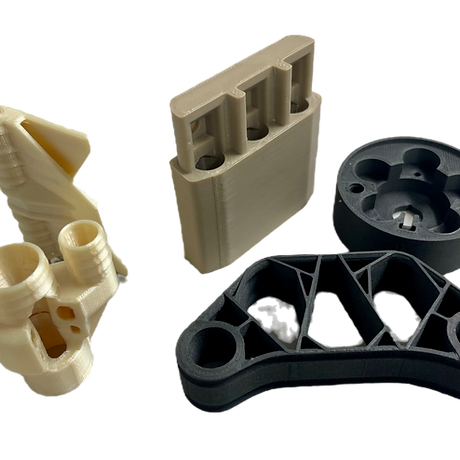
Before we go into the details: Here are the key differences in brief:
PEEK is the stronger, more temperature-resistant, and more chemically resistant material – and correspondingly more expensive. ULTEM (PEI) is the pragmatic compromise for many demanding applications where PEEK is simply not necessary.
PEEK and ULTEM:
The most important differences at a glance
Eigenschaft | PEEK (natur) | ULTEM 9085 | ULTEM 1010 |
|---|---|---|---|
Continuous operating temperature | 260 °C | 167 °C | 213 °C |
Tensile strength (XY, FFF) | ~100 MPa | ~60 MPa | ~65 MPa |
E-modulus (XY, FFF) | ~4,000 MPa | ~2,200 MPa | ~2,600 MPa |
Chemical resistance | Very high | Medium | Good |
Hydrolysis resistance | Up to >250 °C | Limited | Good |
Flame retardant (UL94) | V-0 | V-0 | V-0 |
Biocompatibility | Yes (ISO 10993) | Restricted | Restricted |
Food contact | Yes (FDA/EU) | No | Restricted |
Printability | Demanding | Moderate | Moderate |
Relative material price | €€€€ | €€€ | €€€ |
All specifications refer to FFF-printed test specimens. Values may vary depending on printing parameters.
What is PEEK?
PEEK (polyetheretherketone) belongs to the polyaryletherketone (PAEK) family and has been considered a reference material for extreme applications for decades. The material is semi-crystalline, which gives it an exceptional combination of mechanical strength, thermal stability, and chemical resistance.
In additive manufacturing, PEEK is the material of choice when there can be no compromises: corrosive media, continuous operation at temperatures above 200 °C, contact with food or biological systems, or simply when a component needs to last as long as possible. Malping processes PEEK both as a filament (FFF) and as granules using pellet printing (FGF, AIM3D ExAM 510).
What is ULTEM/PEI?
ULTEM is SABIC's brand name for polyetherimide (PEI) – an amorphous, high-performance thermoplastic originally developed by General Electric. The two industrially relevant variants are ULTEM 9085 (optimized for aerospace applications, with a fire rating according to FAR 25.853) and ULTEM 1010 (higher temperature resistance, FDA-compliant variant available).
ULTEM is easier to print than PEEK – the print chamber temperatures are lower, and the warpage behavior is more manageable. This makes ULTEM the preferred choice for functional components where PEEK would be technically overkill.
Mechanical and plant engineering:
Wear rings, plain bearings, bushings, and sealing components that are permanently in contact with aggressive media or high temperatures are preferably made of PEEK. For mechanically stressed brackets and jigs without chemical exposure, ULTEM 1010 is often sufficient.
Chemical and process industries:
Pump components, valve seats and sealing housings in chemically exposed environments almost always require PEEK – the chemical resistance of ULTEM is insufficient for concentrated acids or alkalis.
Aerospace / Defence:
For interior components with fire protection requirements according to FAR 25.853, ULTEM 9085 is the established choice and often required by certification regulations. PEEK (possibly CF-PEEK) is used for high-load structural components or thermally stressed exterior components.
Medical technology:
PEEK is biocompatible according to ISO 10993 and sterilizable – a property that ULTEM does not possess in this form. PEEK is the standard material for instruments, holders, and patient-contact components.
Food industry:
PEEK is biocompatible according to ISO 10993 and sterilizable – a property that ULTEM does not possess in this form. PEEK is the standard material for instruments, holders, and patient-contact components.
Research & Development:
PEEK is biocompatible according to ISO 10993 and sterilizable – a property that ULTEM does not possess in this form. PEEK is the standard material for instruments, holders, and patient-contact components.
Typical applications:
Which material is used where?
Is ULTEM always cheaper than PEEK?
Generally, yes – both the raw material and printing costs are lower with ULTEM. However, the overall costs of PEEK components can be offset by their longer lifespan or the elimination of downtime. For short-lived functional prototypes, ULTEM is almost always the more economical choice.
Can Malping supply both materials?
Yes. We process PEEK (natural, GF20, CF30) and ULTEM (9085, 1010) using the FFF process. PEEK is also available as granules for FGF pellet printing – this makes larger components significantly more economical.
Is there an alternative to both materials?
For certain applications, PEKK (polyetherketoneketone) can be an interesting alternative – similar properties to PEEK, but with different processing characteristics. PPS-GF (polyphenylene sulfide) is also an option for chemically demanding environments at somewhat lower temperatures. Contact us – we are familiar with the entire spectrum.
How long does delivery take?
We typically manufacture small batches and individual parts from PEEK or ULTEM within 10 working days, depending on component complexity and quantity. For express deliveries, please contact us directly.
Ready to make the right material decision?
PEEK or ULTEM – we'll help you make the right choice. Send us your drawing and/or CAD file and briefly describe your requirements. We'll get back to you personally.
Malping GmbH
Mörikestraße 29
(Production: Mörikestraße 30)
D-73765 Neuhausen auf den Fildern
Tel: +49-7158 9823230
Email: info@malping.de
If you already have a 3D model and would like to request a quote directly, please send us an email:info@malping.de
For general inquiries, please use our form:
Request a free PEEK datasheet!
Technical specifications and operating limits
for PEEK, GF- and CF-PEEK in FFF/FGF printing
compact on one page.